

Black Ops 2 is a game that needs no introduction.
Released on November 13th 2012 for the PlayStation 3 and Xbox 360, It made $500 million dollars in revenue in its first 24 hours and $1 billion in its first 15 days, making it the fastest entertainment property to reach this milestone. It was the best selling game of 2012, selling over 24 million copies in its first year. With a peak of 2 million concurrent players across all platforms, and by August 2013, almost 100 million people had played the franchise. A cornerstone of all of our childhoods, Black Ops 2 is one of the top 40 best selling video games of all time, so what happens when I want to boot up a match in 2025?

Although once the most played game of 2012, the landscape of lobbies once populated with millions of human users has been reduced to an unplayable mess. Bots exploit each other in perpetuity creating a hostile environment for real players who are insta-killed, deranked, and hacked upon entering a match. Steam players are even exposed to full attacks on their system via remote access trojans. Seeing a once beloved game in this state is like seeing a burnt down house. The architecture is there, the memories, but nothing human remains. This is analogous to the internet in the late 2020s.
We are spiraling toward a world where the open web, like these lobbies, becomes a hostile wasteland. Where logging on is tantamount to jumping in a cage with a tiger. The ‘Dead Internet’ isn’t just a theory anymore; the threshold has been crossed, and it is already too late. I am not breaking a story or providing a new take. I’m writing this to scare you and hopefully, to give you a concrete idea of where things are heading in the second half of the 2020s. These are the stories from 2025 that prove, unequivocally, that the internet as we know it is dying.
Prompt Driven Cyber Attacks:
Starting off, I want to skip the fluff and cover the most important story of the year. A story that, unless you’re interested in this stuff, you would have only seen briefly.
In September 2025 a Chinese state sponsored group utilized Claude to commence a cyber attack on roughly 30 American companies. Mainly tech companies, financial institutions, chemical manufacturing companies, and government agencies. In a report released in November 2025, Anthropic, the creator of Claude, said they “detected suspicious activity” which was later proven to be the cyber attack in question. However, this wasn’t an ordinary attack. This wasn’t just someone using AI as an advisor, This was “the first documented case of a large-scale cyberattack executed without substantial human intervention”. In other words, it was prompt driven. Someone had launched a cyber attack through vibe coding.
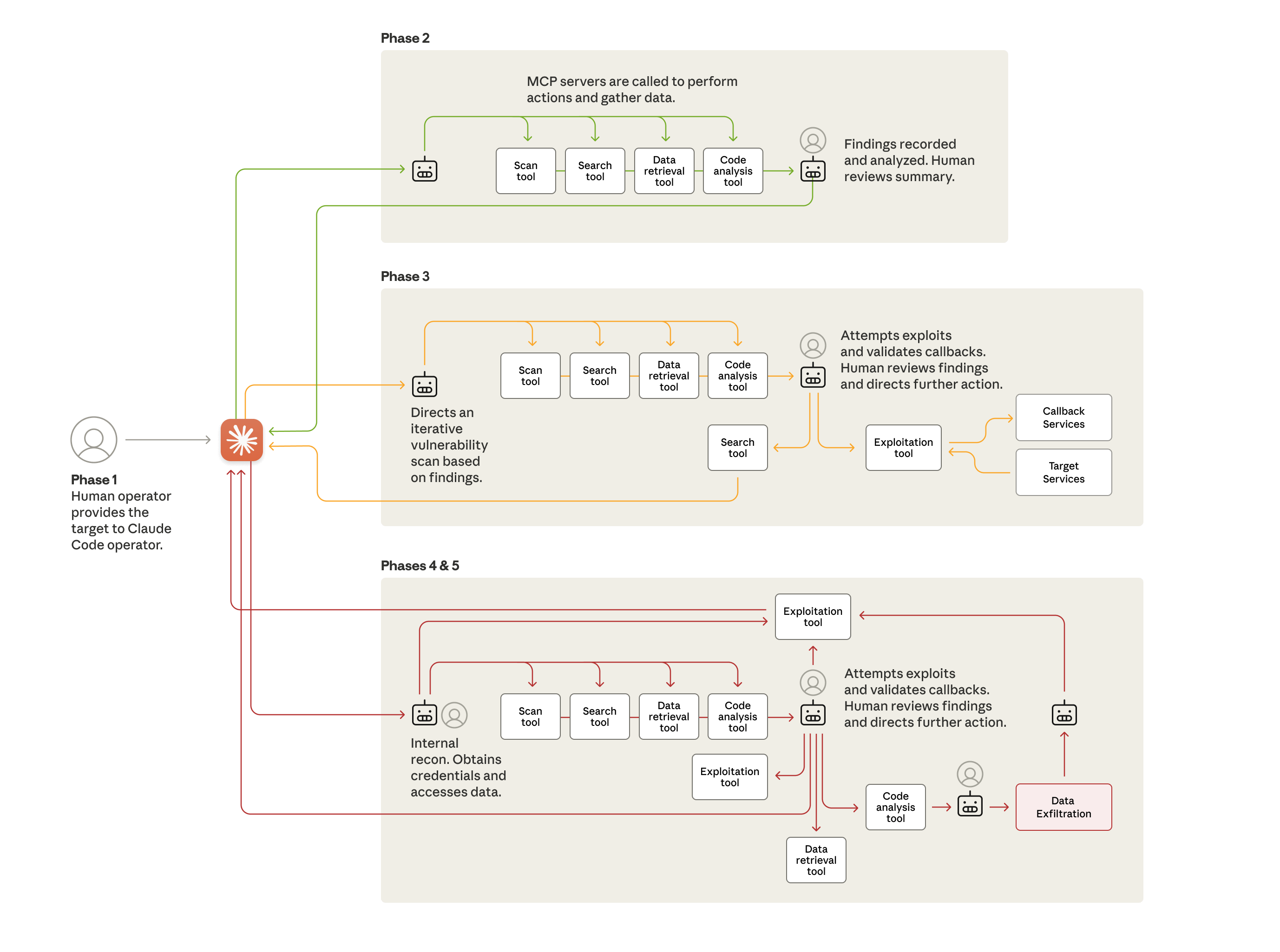
In the report on Anthropic’s website, they detail exactly how this attack worked. This user used Claude code as an automated tool to infiltrate chosen targets. They then jailbroke Claude convincing it to carry out the tasks. The user insisted that they were an employee of a cyber security firm and that Claude was being used in defensive testing, breaking the full attack down into individual steps as to not provide full context to Claude. They got Claude to scan the targets for vulnerable data, vulnerabilities in its security, capitalize on said vulnerabilities and catalog the stolen data. This was almost all prompt driven, with a human intervention only 4-6 times according to Athropic. What’s scarier still is the time it took to do this. At certain points in the process, Claude was making thousands of requests, often multiple per second. This is beyond any human capability. Something that would have taken a team months, took a single user and an AI agent several hours.
At the end of Anthropic’s report on the matter, they add this quip which illuminates the terrifying philosophy AI companies have adopted,
“If AI models can be misused for cyberattacks at this scale, why continue to develop and release them? The answer is that the very abilities that allow Claude to be used in these attacks also make it crucial for cyber defense”.
This tows the line that all AI companies have been pushing; It’s an arms race and cybersecurity must always be a step ahead of threats, but this isn’t an arms race, it will never be an arms race.

This story shows that cyber security is actually a step behind potential threats. What Anthropic is talking about is actually closer to gain-of-function research where the threat comes first and the solution comes after. If China steals the nuclear launch codes via vibe coded cyber attack, will it matter that Anthropic learned how to prevent the next one? We’re facing a looming threat of prompt driven cyber security attacks utilizing technology that didn’t exist even a year ago and nobody seems to fucking care.
This sentiment best sums up everyone’s thoughts on technology in 2025, nobody seems to fucking care. We are having the very architecture of the internet ripped out from under us. We, the users, the creators, the ones who make the internet useful. Without us, there would be nothing here, nothing to view, and cynically, no money for advertisers. The internet is on life support because of companies that hold 6% of the American GDP without ever turning a profit.
Hyperscaling
This idea of profitless companies isn’t at all foreign in our late-stage C-word society. A process known as blitzscaling, companies run at a loss to corner the market as fast as possible until their product is the only option. Spotify ran at a loss for almost two decades and in the process made music streaming the most important avenue for artists, with Spotify as the clear platform of choice. Uber ran unprofitable for almost a decade, yet “Ubering” is now far more ubiquitous than “calling a cab”. Blitzscaling works and investors know this. Hence why they are willing to throw money at start-ups for years knowing eventually they’ll have a piece of a company that might be worth trillions of dollars. As ridiculous as this process sounds, it’s becoming so much worse.

It’s not the 2010s anymore, Scott Pilgrim isn’t ordering stuff from Amazon to impress Ramona Flowers because it’s cool and hip. These companies are our overlords that hold the entirety of our data and the American economy in their cold, hairless, soy-boy hands. Take for example the circular revenue phenomenon.
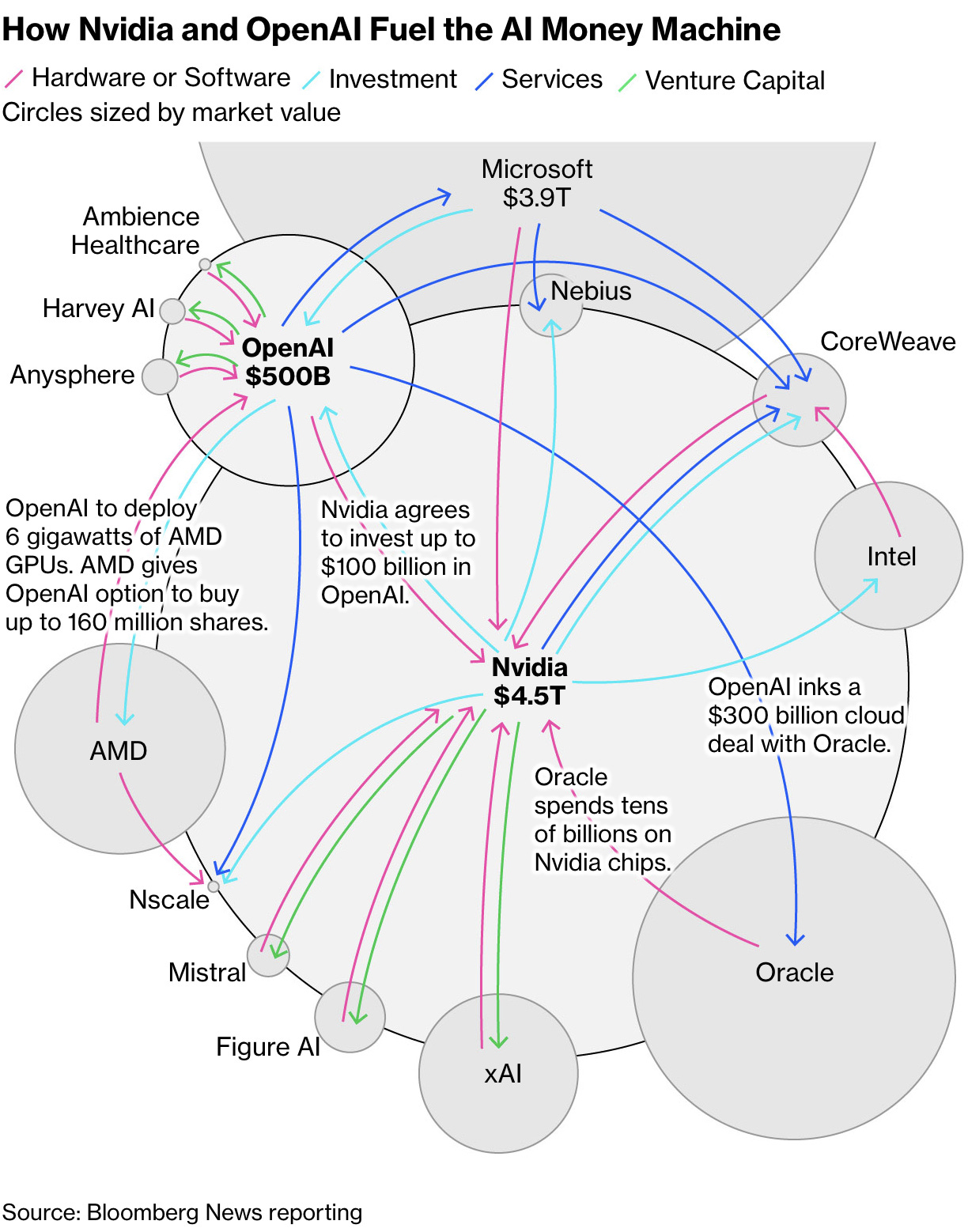
This chart did the rounds on Twitter and there are many good videos by financial experts that cover it in way more detail than I will, (I’ve linked a great one by Sasha Yanshin). But basically, Big tech has undertaken the act of “round tripping”, a normally illegal form of securities fraud with which companies artificially inflate their revenue. Best summed up by this YouTube comment.

A hyperscaler giant like Amazon or Microsoft gives an AI company like Open AI or Anthropic a $10 billion dollar investment. However, this investment comes with a catch. They contractually have to spend that $10 billion on said investors computing or cloud services. The money is then put back in the initial investor and the $10 billion is recorded as growth for both companies leading to a rise in market share and valuation. Never forget; Money is just how poor people conceptualize power.
OpenAI has already committed $1.4 trillion dollars for computation and isn’t expected to run a profit until the 2030s. This isn’t to mention the fact that AI has gutted the consumer hardware market. With Micron, the world’s third biggest supplier of RAM, pulling out the consumer market all together. Or that consumer RAM chips have already basically sold out for 2026 with companies now bidding on 2027s RAM supply. OR that new consumer technology will stagnate and be less powerful than early 2020s models because of the shortage of consumer hardware via AI companies. (highly recommend Netloss’ video on this topic), but that’s not what this essay is about.
This is about your experience as a user of the internet. So, what are these companies doing with 6% of the American GDP, 67% percent of GDP growth, and the next decade of hardware production in the palms of their low testosterone hands? Among countless existential privacy violations, they are making the Internet unusable.
The Great Replacement.
2025 is the year humans became a minority on the internet.
It’s not just AI slop, slop was so 6 months ago. Earlier this year we were all complaining about the proliferation of AI content getting in the way of user generated content on our social media feeds. A phenomenon that we began to accept as part of navigating the digital landscape, but what most people don’t take into account is the sheer speed at which AI content can be proliferated and what that means for the future of our platforms. Here’s a great example.
In 2025, an average of 34 million AI images were generated daily. That works out to almost 13 billion images over 365 days. That’s about how many photos were taken by humans in the first 149 years of the existence of photography. Now, this first 150 years is 1826 to 1975 and doesn’t include smartphones. If you look at just 2025 that number is around 2 trillion human photos taken. A number that far surpasses the 13 billion AI generated images, but there’s a key difference. You don’t upload every photo you take. If you take 50 photos of your penis, only one or two of those are going on the Tubbo Discord, but every image you generate is used as data. Data that will feed back into the image generation model and affect its outputs. Outputs that outweigh human influence online.
As of the end of 2025, there are now more new AI generated articles than human generated articles according Graphite, an SEO company. It’s nearly impossible to track as it’s happening so fast but some reports put the amount of AI content generated on social media as over 70%, and 2025 marked the year that bot traffic fully surpassed human traffic on the internet. Since 2022, AI experts have converged on the idea that by 2026, 90% of all content on the internet will be AI generated. This is almost 35 years of human generated internet content being usurped by technology that only became popular in mid 2022. It took two and a half years for humans to become the minority on the internet, what will happen in the next five, and what does that mean for genuine creators?
Incentives.
Spotify uses a revenue pool to pay its artists. Subscription income is collected together then distributed out to artists based on their share of total streams on the platform. In a vacuum, this system works well enough, but what if I were to upload millions of AI generated songs, plant them in playlists so you don’t know you’re listening to AI music, rack up millions of plays, and collect money from the revenue share? I’d be a gen-z business genius, but I’d also be late to the party.
Around 25% of all music uploaded daily to Spotify is AI generated. According to CISAC, this will amount to artists losing a quarter of their streaming revenue by 2028, about $11.7 billion in total gone to AI music. Songs like “We are Charlie Kirk” Which topped Spotify’s charts after going viral on Tik Tok. a song that got three million streams amounting to about $11k USD. Money stolen from the pockets of real musicians trying to make a living. Funny enough, Spalexma, the anonymous group that published We Are Charlie Kirk, initially started creating AI songs in Russian before following up their debut slop with 2024s hit album. “Santa Kiss My Mom”. Music that is copyrighted. If you were to use it in a YouTube video, your video would be struck and all of its revenue would be diverted to Spalexma, an entity that is almost certainly a Russian asset.
This is bad, of course this is bad. Nobody thinks this is a good thing. So surely platforms are working tirelessly to solve this problem right?
First of all, the energy cost to effectively filter out AI content that is being exponentially mass produced is simply too great. Using the gain of function argument from before, AI will all always be ahead of preventative systems. Please, let me repeat that. By definition, in order for AI to be used to solve a problem, there has to be a problem to solve. If nothing changes, even if tech CEOs were as alarmed as you or me, this problem is impossible to solve without AI regulation at an institutional level. Considering that every major government is actively deregulating AI, with the Trump administration barring AI regulation at the state level, there is no way to stop the slopification of platforms. But the CEOs don’t care. In fact, they are actively cheering for the slopification of everything.
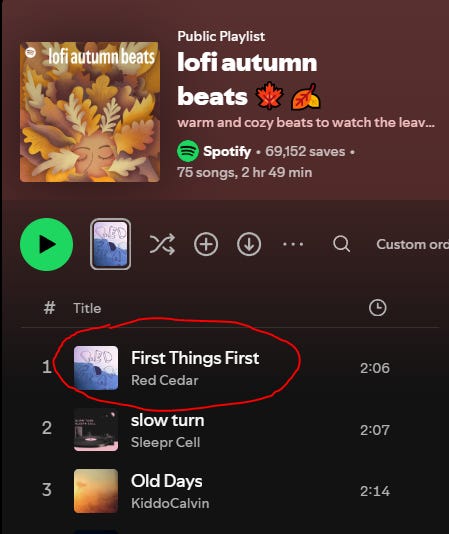
Open Spotify right now and look up the playlist “LoFi Autumn Beats”, a playlist made by Spotify with 68k saves. Click on the first artist featured named “Red Cedar” an artist with almost 500k monthly listeners. Take five minutes and try to find a single piece of information on this artist. You can’t. This is because this artist is what’s known as a “ghost artist”. Ghost artists are fake assets that pump out hundreds, sometimes thousands of tracks to fill out playlists. Spotify cuts deals with companies that produce ghost artist music like Firefly Entertainment and Epidemic Sound. Often promising them less royalties in return for a guaranteed spot on playlists. (if you want to dive deeper into this I highly recommend Liz Pelly’s work on the topic). This Ghost artist practice has already been infiltrated with fully AI music and the structure exists to incentivize more AI generated music in the form of deals with production companies.
Spotify directly benefits from AI music on their platforms. If it was up to Spotify, every user would be listening to AI lo-fi playlists made either by companies they have low royalty deals with or by their own in-house production company. Unless there is specific regulation put in place, this problem will only get exponentially worse. 84% of music revenue comes from streaming platforms and there is currently no major alternative for artists to make a living.
In terms of Meta’s platforms, the incentive is the same; if you remove the human, you don’t have to pay anyone for content. In an internal meeting at Meta in May 2025, Zuckerberg announced what he called “Infinite Creative”. A program with which advertisers no longer have to create ads themselves. Instead, they tell Meta their goals and targets and Meta generates thousands of ads hitting millions of users, all while simultaneously A/B testing them to find the one with the highest conversion. A service expected to be rolled out by 2026. This is on top of what we’ve already known for years; the algorithm is constantly tweaked to keep you on longer. Every second you watch or don’t watch a piece of content is data that is used to show you the next piece of content. Every time you comment “this is AI” on an AI video, it’s recorded as engagement. AI content to keep you engaged long enough to show you AI ads. Again, this is gain-of-function research. No matter how much you try to avoid short from generative content on these platforms, no matter how healthily you try to use them, that data is recorded and used against you. In Meta’s eyes, you are the virus and AI is the cure.
I want to take a second to tie this to one of the greatest contemporary philosophers, Byung Chul Han. In Han’s Essay, The Scent of Time, He argues against the idea that time is accelerating. As our lives seem to get quicker and quicker, the days going by shorter and shorter, we attribute this to our busyness and the work demanded of us. For Han, this isn’t the case. Han diagnoses this symptom of accelerating time. Not to our busyness, but the fact that every moment of our day is divided, something he calls “temporal dissipation”. As we rush through the day, jumping from one task to the next, phone checked, email answered, coffee grabbed, project finished, another holiday or milestone passed with no time to stop and contemplate, we lose sense of narrative in our lives. Like a dog losing the scent of an animal it’s hunting. Our existence becomes a slog of disconnected points and tasks, no crescendo, no hero’s journey, just noise. We are asked to continue to divide our time between ever increasing and disconnected points as it’s what life now demands of us. We don’t exist as a whole, just thousands of isolated presents. This is the modus operandi of AI. Thousands upon thousands of disconnected data points forming thousands upon thousands of disconnected generative assets all exponentially fractaling into an ever-deafening symphony of white noise, and nobody seems to care.
I’ve framed this essay as if all 8 billion of us are imbued with this indomitable spirit with which we use to fight the ever lasting war on our souls, but a fear that we don’t. We will continue to stare into the pleasure machine. We will continue to fill our days with generative noise and the powers that be will continue to be incentivized to make it worse. There will come a time very soon where operating on the open web is functionally useless, where creating is impossible and the web is an infinite void of slop and scams. What will remain of the single greatest piece of human achievement? Our only hope is to hide.
THE DARK FOREST:

There’s a mod project for black-ops 2 called Plutonium. It’s a mod you can download to play on private servers, servers with anti-cheat rules that ban modded players. Servers that functionally exist as Black Ops 2 did back in 2012, free from the prying eyes of hackers and cheaters who would otherwise prey upon you. In a world too dangerous to expose oneself, Black Ops 2 players have found a safe place to hide. This is an example of the dark forest theory of the internet.
First coined by Kickstarter co-founder Yancey Strickler in a private essay in 2019, This idea builds on Lui Cixin’s theory from his sci-fi series The Three Body Problem. The theory goes that when we look out into space, we see a black expanse, devoid of life. This doesn’t imply that nothing is there, it means that whatever is out there is hiding. They’ve learned to stay silent for fear of what might find them if they make themselves known. Like animals hiding in a dark forest from nighttime predators.
The dark forest theory of the internet follows the same logic; as humanity is increasingly drained from the internet, as exposing oneself becomes evermore dangerous, the internet seems more lifeless. People are there, but they are hiding. Hiding in encrypted chats, message boards, forums, discords, private Instagram pages, or private black-ops 2 servers.
Even we are hiding here in the instance of this long form essay. You, reading this, can confirm this is me. You found this Substack from my Patreon or my YouTube videos. There are years of context proving you are reading an essay written by me. There has yet to exist an AI that could faithfully recreate this. The context, the narrative arc of my life, etc. You could ask Chat GPT to write an essay in the Style of Brogan Woodman. You could generate ten seconds of an Art Chad video on Sora. On X or Instagram reels or Tik Tok I may be fake, people may use my likeness or voice to harm you, but those are just disconnected points free from context and the scent of time. Here, hiding in this increasingly dark forest, you can confirm I am a user.
The local first movement is another example of users hiding in the dark forest. An inversion of data authority in which people aim to store data locally, rather than on clouds. This ensures full read/write functionality without internet connectivity and that data will remain accessible over time. As everything becomes compromised, as platforms become unusable for anything meaningful, these forms of “hiding” become paramount. Is this the direction the internet is going? A backpedaling toward 80s style computing where everything is locally hosted, or will our digital lives become bifurcated as we hop onto the open web to do basic tasks while spending most of our time in hiding? Regardless, a solution is now unavoidable. The function has been gained and the virus is terminal.
The Forest Dims.
Whatever it was that we had for the past two decades, is dead.
Like Black ops 2, a platform once filled with memories, joy, and humans, it will be gone. Overrun by bots and irreparably unusable to any human. An abandoned universe whose fake users will generate slop and prey upon each other in perpetuity for the rest of time if the servers stay up. You can’t do anything about this, all you can do is open social media and helplessly watch the chaos unfold. There’s no turning back now
If you’re reading this now, in late 2025, you might think I’m catastrophizing. If you’re reading this in 2027 or 2030, you already know I wasn’t.
Maybe something has happened since the release of this essay at the end of 2025. Some unforeseen cyber attack has registered online banking unusable. Maybe Instagram has been a long abandoned platform flooded with billions of hours of AI generated content. Perhaps you are looking back on Tik Tok as some archaic app that gen-z used, baffled that your parents dared to engage with such an open and public platform. Your father explains YouTube to you like our parents explaining what it was like to travel before 9/11. Whatever has happened, you may look at these potential events and claim them to be the catalyst of a dead internet, but they won’t be. They won’t be because the bomb had already begun ticking. Rewind a few years and we had a chance to prevent this, but it is now too late. 2025 is the year the internet went terminal
NKYS.